
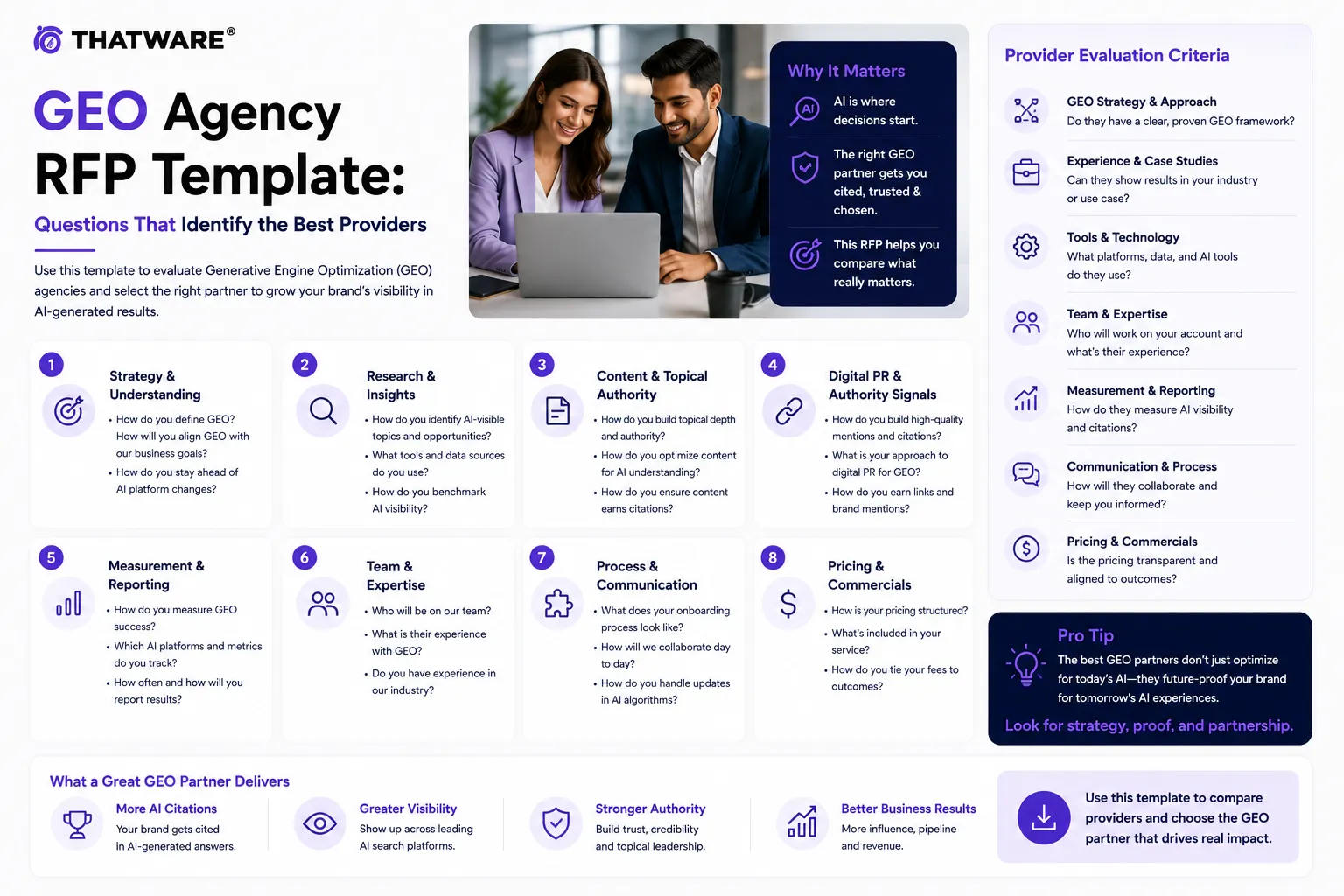
Hiring an agency for any new marketing discipline is tricky. You’re evaluating expertise in something you don’t fully understand yet, using criteria you’re still developing. Add in the fact that GEO is a relatively young field with inconsistent terminology, varying approaches, and a healthy number of providers overpromising what they can deliver — and the selection process gets genuinely complicated.
The RFP process, done well, cuts through a lot of that noise. The right questions reveal who actually has depth versus who has a polished pitch deck. This guide gives you the questions that matter most, and what good answers look like.
Before You Send an RFP: Know Your Starting Position
A few things are worth clarifying internally before you put an RFP in front of agencies.
What’s your current GEO baseline? If you haven’t done even a basic audit of your AI citation presence, you’ll get more value from RFPs if you’ve at least run your top 20-30 target queries through ChatGPT and Perplexity and noted where you appear. Agencies will ask about your starting point, and having some data makes the conversation more substantive.
What are your primary objectives? AI citation rate improvement? Competitive share of AI voice? Visibility for specific product lines or buyer personas? The more specific you can be, the more useful the RFP responses will be.
What’s your realistic budget range? GEO engagements vary widely in scope. Knowing whether you’re looking at a focused startup-scale engagement or a comprehensive enterprise program helps agencies scope appropriately.
The Questions That Separate Real GEO Expertise
“How do you define GEO success, and how do you measure it?”
This is the most revealing opener. Strong answers include specific metrics (citation rate, prompt coverage, share of AI voice, AI referral traffic) with clear methodologies for tracking them. Watch out for answers that lean heavily on traditional SEO metrics like traffic and rankings without addressing AI-specific signals. That’s a sign the agency is repurposing an SEO framework rather than operating a genuine GEO practice.
“Walk me through your approach to prompt landscape mapping.”
Every credible GEO agency should have a defined process for identifying the specific questions target buyers are asking AI systems in your category. Strong answers describe a systematic methodology — not just keyword research, but active querying of AI platforms, analysis of query patterns, and mapping to buyer journey stages. Vague answers (“we research the relevant topics”) suggest this isn’t a developed capability.
“How do you handle entity optimization, and what’s your process for auditing entity health?”
Entity optimization — ensuring your brand is consistently and clearly identified as an entity across the web — is a core GEO function. Agencies that can’t speak clearly to this are missing a critical piece of the practice. Good answers describe auditing schema markup, cross-platform consistency, author entity presence, and structured data implementation.
“Show me examples of AI citation improvements you’ve achieved for clients, with before/after data.”
This is where the real differentiation happens. Ask for case studies with specific metrics — baseline citation rate, target prompts, citation rate after six and twelve months. Be skeptical of case studies that describe “content strategy” and “SEO improvements” without specifically addressing AI citation performance. Plenty of agencies are rebranding existing services as GEO without having actually built the capability.
“Which AI platforms do you track, and why?”
A strong answer covers at least ChatGPT, Perplexity, Google AI Overviews, and Bing Copilot — with a rationale for why each matters for your specific category. An agency that only tracks one or two platforms, or that doesn’t have a clear methodology for tracking AI citations at all, has limited operational depth.
Questions About Process and Integration
“How do you integrate GEO with an existing SEO and content program?”
GEO should complement, not replace, existing programs. Strong agencies describe clear integration points — how GEO informs content strategy, how SEO technical work supports entity optimization, how PR and earned media feed into citation authority. Watch for approaches that position GEO as entirely separate, which often leads to duplicated effort and misaligned priorities.
“What does your reporting cadence and format look like?”
You want to understand what you’ll actually receive, how often, and what decisions it’s designed to inform. Weekly spot-checks on key prompts, monthly full reporting across core metrics, quarterly business reviews — a well-defined cadence suggests an agency that treats reporting as a genuine accountability mechanism, not a post-hoc rationalization.
“How will you work with our internal team?”
The answer here should reflect your actual team structure. If you have a strong content team, a good agency will describe how they’ll leverage that capacity. If you have limited internal bandwidth, they should describe what they’ll own fully. Agencies that describe a one-size-fits-all engagement model without reference to your specific situation are probably working from a template.
Red Flags to Watch For
Guaranteed ranking positions in AI answers. No legitimate agency can guarantee citation placement in AI-generated answers. The systems are probabilistic and continuously updated. Anyone promising guaranteed positions is either overstating their capabilities or misrepresenting how AI systems work.
Heavy emphasis on content volume. GEO success isn’t primarily a content volume game. An agency that leads with “we’ll produce X articles per month” without discussing entity optimization, prompt landscape mapping, and external citation building is providing a traditional content service with a GEO label.
Inability to explain their methodology in plain language. If an agency can’t explain their core approach clearly to a non-technical stakeholder, that’s a concern. Good GEO practitioners understand their work well enough to explain it simply.
No before/after citation data. Every agency should have at least some clients for whom they can show measured AI citation improvement. An inability to provide this — even anonymized — suggests either a very new practice or results that don’t demonstrate improvement.
The Decision Framework
When evaluating responses to how to choose a GEO agency, weight the following roughly:
Evidence of results (40%): Can they demonstrate measured AI citation improvements for clients in comparable situations? This is the most important criterion.
Methodological depth (30%): Do they have systematic approaches to prompt mapping, entity optimization, content strategy, and measurement — or are they figuring it out as they go?
Integration capability (20%): Will they work effectively with your existing marketing function, or create friction and silos?
Communication and fit (10%): Will the working relationship be productive? Do they listen and adapt, or pitch a fixed solution?
The agencies worth working with to hire best GEO agency for enterprise level work will welcome detailed questions about their methodology and evidence. Confidence that holds up under scrutiny is exactly what you’re looking for.
The RFP process is only as useful as the questions you ask. Ask about specific evidence, specific methodology, and specific measurement — and the agencies with real depth will distinguish themselves clearly.